

Retail and F&B Shopping Mall Leasing Is Unlike Any Other Type of Real Estate: How to Create Destinations That Matter to People
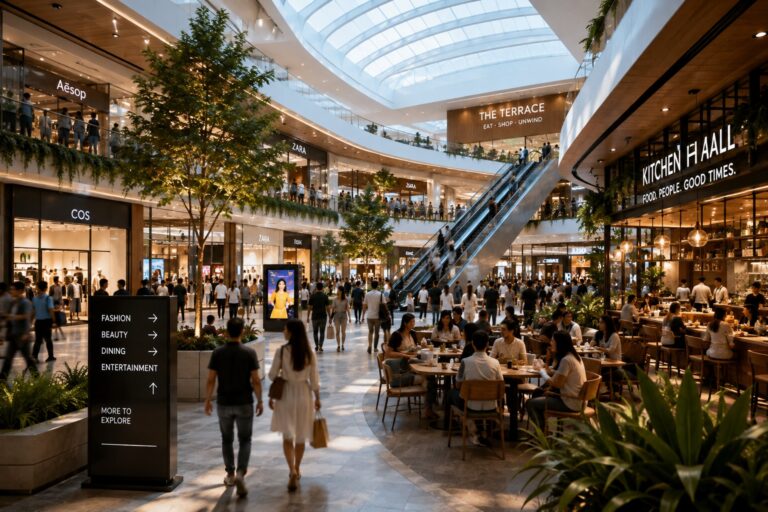
Our advisory work across the GCC and MENA over the years has stretched from retail assets with great vibrancy in their communities to malls laden with vacant units. The difference rarely lies in location; it comes down to how retail landlords operators make leasing decisions from day one.
It’s important to talk about what we have learnt with regard to putting together retail and F&B leasing strategies that actually work, where developers have gone wrong.
Key Takeaway:
- Retail leasing is a long game, and the tenant relationships matter more than the terms of an individual lease.
- All shopping centre analysis based on market research or leasing strategy should start with a rigorous retail feasibility study.
- Tenant mix is the product of true trade area demand, not convenience.
- A strong F&B offer is now driving footfall, not a secondary category.
- Leasing and placemaking should not be an afterthought during the development program.
Why Retail and F&B Mall Leasing Requires a Different Strategy
In our experience, leasing a shopping mall is not similar to leasing office space or residential units. As individual lease terms are signed with various tenants, success relies upon tenant-to-tenant interactions; it is collective success for all that must be the priority.
At PHIL McARTHUR & PARTNERS, Retail Development Specialists, we never approach a shopping centre development strategy based solely on available square metres. Our leasing strategies are based on the desired competitive position, trade area consumer demand, and a critical look at the goods and services needed in each market.
The Importance of a Strong Retail Leasing Strategy for Shopping Malls
A curated retail leasing strategy as the backbone that would ultimately decide if a mall succeeds or fails. The strategy focuses on tenant selection based on real demand instead of assumptions.
A professional process starts with a comprehensive retail feasibility study where market research digs deep into the catchment area characteristics, expenditure patterns, and competing supply.
With our team having more than 150 years of combined experience at PHIL McATHUR & PARTNERS, we firmly believe we’ve learnt what makes or breaks a successful retail destination commercially. Attainable means that we take on feasibility with real demand signals, not optimistic forecasts.
The following are the critical components that make a great leasing strategy:
- Researching and refining the competitive position of the project in the trade area
- Strategic placement of anchor tenants to irrigate traffic throughout the mall
- Rental benchmarking based on comparable assets and sales performance
- A pragmatic phased approach to leasing that follows the construction program
One of the most common mistakes causing underperforming retail across the region is skipping this step or treating it as a formality.
Creating the Right Shopping Mall Tenant Mix for Long-Term Success
We have seen countless times that the tenant mix silently dictates success or failure in retail projects. A mix that is based on poor assumptions or developer ego is seldom a driver of footfall.
At PHIL McATHUR & PARTNERS Retail Development Specialists, we’ve learnt that tenant mix strategy must be rooted in data, not assumptions. Trade area analysis allows you to see who is actually shopping in your trade area, and what you are missing within a few miles of the local area. We also believe in respect for our competition and craft our projects to reflect market opportunities and gaps.
For a balanced tenant mix: we address the following:
- Anchors that drive consistent footfall
- Mid-tier retailers with category depth
- Dine-in and lifestyle tenants that will prolong retail asset life
- Niche or local operators who differentiate
How F&B Mall Leasing Drives Footfall and Customer Experience
We have already seen the F&B category evolve from a supporting pillar to being the main traffic driver across GCC & MENA retail assets. Shoppers are now more likely to choose their favourite shopping centre based on dining experiences at the mall.
From our perspective, F+B and entertainment are the new anchors of this millennium. Gone are the days where department stores dominated the mall plan. Creating the right environment or vibe in the mall is important. Planning F+B offerings is complex and can range from Quick Service Restaurants to Fine Dining
Retail Destination Placemaking: Turning Shopping Centres into Community Hubs
In our view, placemaking turns a retail asset from being simply transactional into a destination that brings customers back time and again. It is collectively shaped with design, programming and tenant experience. The retail destination, if managed correctly, can become the focal point of any community. Hosting gatherings and community events can only reinforce this.
PHIL McARTHUR & PARTNERS Retail Development Specialists have deep experience in retail real estate. We have witnessed retail destinations across the GCC evolve; our focus is always on aligning concept, leasing, operations and marketing as a complete package with developers. This alignment allows for avoiding very expensive retrofits post-launch.
Balancing Commercial Leasing Retail Goals with Consumer Expectations
We realise that landlords are focused on getting tenants, and ultimately revenue, while consumers seek ease of use, experience and relevance. The best contenders to balance both without sacrificing either one.
A comprehensive analysis of the retail market guides developers to set targets that are commercially viable in line with a true understanding of what the catchment can deliver.
Common Mistakes in Retail and F&B Shopping Mall Leasing
Over the years, the common issues we see that disrupt retail performance have been:
- Leasing to tenants that are available, as opposed to being a fit for the trade area
- Allocation and weighting for F&B with amenities does not hold up to an increase in traffic
- Disregarding the market conditions and operator requirements
- When placemaking is approached as a later-stage design add-on.
Based on our experience, each of these errors is avoidable with disciplined, data-led planning from the earliest stages of a project.
How PHIL McARTHUR & PARTNERS Delivers Successful Retail Leasing Strategies
At PHIL McARTHUR & PARTNERS Retail Development Specialists, we provide complete retail expertise from insights and concept design review to leasing strategy and turnaround advisory. Our Chairman, Phil McArthur, worked on landmark retail and mixed-use projects for over 45 years in Canada, MENA and Asia. We have assisted with more than 210 completed projects in more than thirty countries.
This has given us hands-on experience across our biggest landmark developments that we’ve worked on, such as Jeddah Central Development, DIFC Dubai, Lusail Boulevard Qatar, and Al Jada Central Hub Sharjah, Granada Mall, Riyadh, into what makes retail destinations commercially or experientially
FAQS
What is a retail leasing strategy, and why is it important for shopping malls?
We view it as an organized strategy aligning tenant mix composition, positioning and commercial terms to validated market demand with diminishing vacancy risk over time.
How does F&B mall leasing improve shopping centre performance?
Often underestimated, F&B in our experience significantly increases visitor dwell time and repeat visits, making it a primary footfall and revenue driver rather than an ancillary category.
Why is the shopping mall tenant mix critical to long-term success?
What we found is that the right combination breeds complementary categories that keep the asset top of mind with its catchment, delivering ongoing footfall beyond the opening window.
What is retail destination placemaking, and how does it benefit developers?
Placemaking is a blend of design and programming with leasing, creating community destinations over transactional environments like malls.
How can commercial leasing retail strategies increase occupancy and customer engagement?
We believe that by anchoring leasing decisions in the trade area and feasibility analysis, we can help developers mitigate mismatches between tenant offer and consumer demand.