

Retail in Master Planned Communities: Stop Guessing, Start Planning

Introduction
One of the most consequential, and most frequently mishandled, decisions in masterplan development is how much retail to include, where to put it, and what form it should take. Get it right, and retail becomes the social spine of a community. Get it wrong, and you are left with vacant podium units, underperforming strips, and amenity gaps that erode both liveability and asset value.
At PHIL McARTHUR & PARTNERS, we pride ourselves on the deep experience we have across the MENA region. Here is how we approach it.
Step 1: We Start with Population, Not Hectares
Retail quantum is not a function of the masterplan’s physical size; it is a function of the population it will house and the spending power that population represents. We begin by modelling the resident, office and hospitality catchment at full build-out: the number of households, average household size, income profile, nationality mix, and lifestyle orientation. In the UAE context, this matters enormously. A masterplan targeting Emirati families in Abu Dhabi carries fundamentally different retail implications to one targeting young expatriate professionals in Dubai- different basket sizes, different visit frequencies, different category priorities.
Step 2: We Map the Competitive Context
No masterplan exists in isolation. Before recommending a single square metre of retail GLA, we audit what already exists or is planned within the primary and secondary trade area. In markets like Dubai and Abu Dhabi, retail supply is dense and growing. A masterplan in the orbit of an established regional centre – or positioned between two — faces a fundamentally different retail brief to one in an underserved catchment. Sobha Hartland in MBR City, for example, sits in close proximity to significant existing and planned retail infrastructure; its internal retail therefore serves a convenience and community function, not a destination one. Understanding that distinction is the starting point for getting the quantum right.

Step 3: We Define the Retail Hierarchy
Not all retail within a masterplan serves the same purpose. We work with developers to establish a clear retail hierarchy — typically across three tiers. The first tier covers daily convenience: the supermarket, pharmacy, café, and laundry that residents need within walking distance, ideally without a car journey. The second tier covers community-level amenities: a gym, clinic, casual dining, personal services, and soft leisure that serve the broader neighbourhood and encourage lingering. The third tier — which not every masterplan warrants — is the destination or lifestyle layer: the curated F&B street, the boutique fitness cluster, the weekend market. Saadiyat Island succeeds partly because its retail hierarchy is legible; each layer has a distinct role and a distinct location logic.
Step 4: We Align Retail with Community Structure and Movement
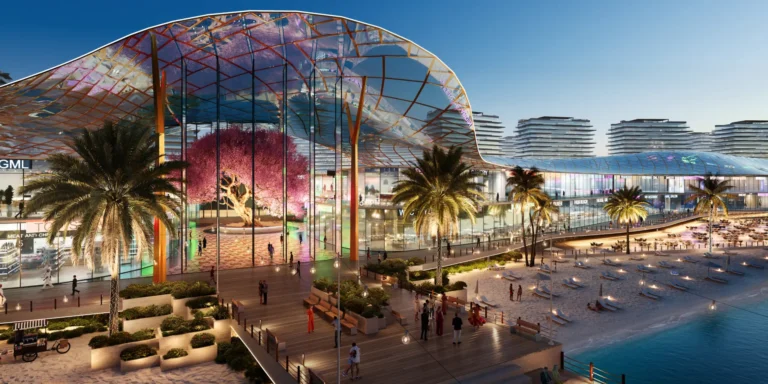
Where retail is placed matters as much as how much retail there is. We analyse pedestrian requirements, vehicular circulation, access points, school and mosque locations, and the positioning of parks and open space – because these are the natural attractors that generate passive footfall. Retail placed in the path of daily movement performs. Retail placed off that path, regardless of how well-designed, struggles. This is a lesson many masterplans in the GCC have had to learn the hard way.
Step 5: We Phase Retail Realistically
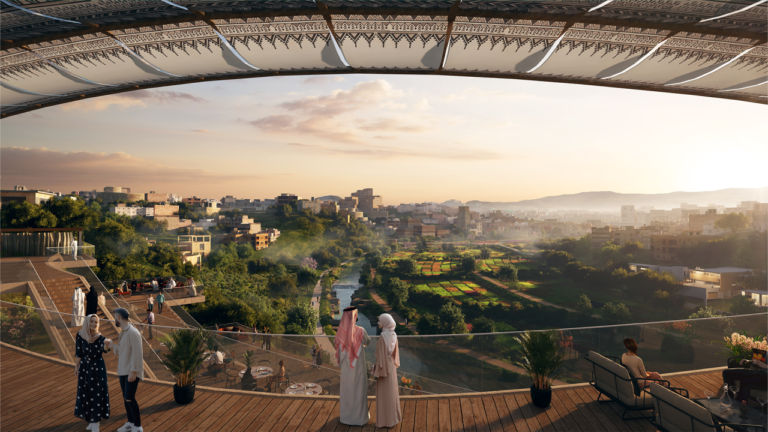
One of the most common and damaging mistakes in masterplan retail planning is activating too much too soon. Retail requires a critical mass of residents, office workers and hotel guests to trade viably – and in phased developments, that population arrives over years, not months. We advise on sequencing retail delivery in direct proportion to population milestones: what opens in Phase 1, what is held back until Phase 2 occupancy thresholds are reached, and what remains as land-banked opportunity for Phase 3 and beyond. This protects landlord income, protects tenants from uncommercial trading conditions, and protects the long-term reputation of the scheme.
The GCC’s pipeline of large-scale masterplans – from Yas Island’s continued expansion to the emerging communities across Saudi Arabia – makes this discipline more important than ever. Retail that is sized correctly, positioned strategically, and delivered in step with population growth will anchor communities and hold its value. Retail that is not will become a liability.
At 𝗣𝗛𝗜𝗟 𝗠𝗰𝗔𝗥𝗧𝗛𝗨𝗥 & 𝗣𝗔𝗥𝗧𝗡𝗘𝗥𝗦 Retail Development Specialists, we work with masterplan developers across the region to define the right retail strategy from the earliest stages of planning – before decisions become difficult to reverse.
If you are planning a large-scale residential development and want to get the retail right from the outset, we would welcome the conversation: info@mcarthur-specialists.com | www.mcarthur-specialists.com
#RetailStrategy #MasterplanDevelopment #RetailRealEstate #CommunityRetail #Placemaking #UAERetail #GCCRealEstate #MixedUseDevelopment #RetailPlanning